I still remember the exact moment I hit “Create Pull Request” like I was launching a rocket.
It was my first week as a junior developer. I’d been assigned a “small” task: add a validation check to a signup form and tweak the error message. It sounded simple. I finished it in one sitting, ran the tests (well… one test), and proudly opened my first PR.
Then I waited.
I imagined someone on the team reading my code and thinking: Nice. Clean. Promising.
I imagined a quick ✅ and maybe even a “Great job!”
What I got was… a comment thread.
A long one.
The Review That Felt Like a Punch (Even Though It Wasn’t)
The first notification popped up:
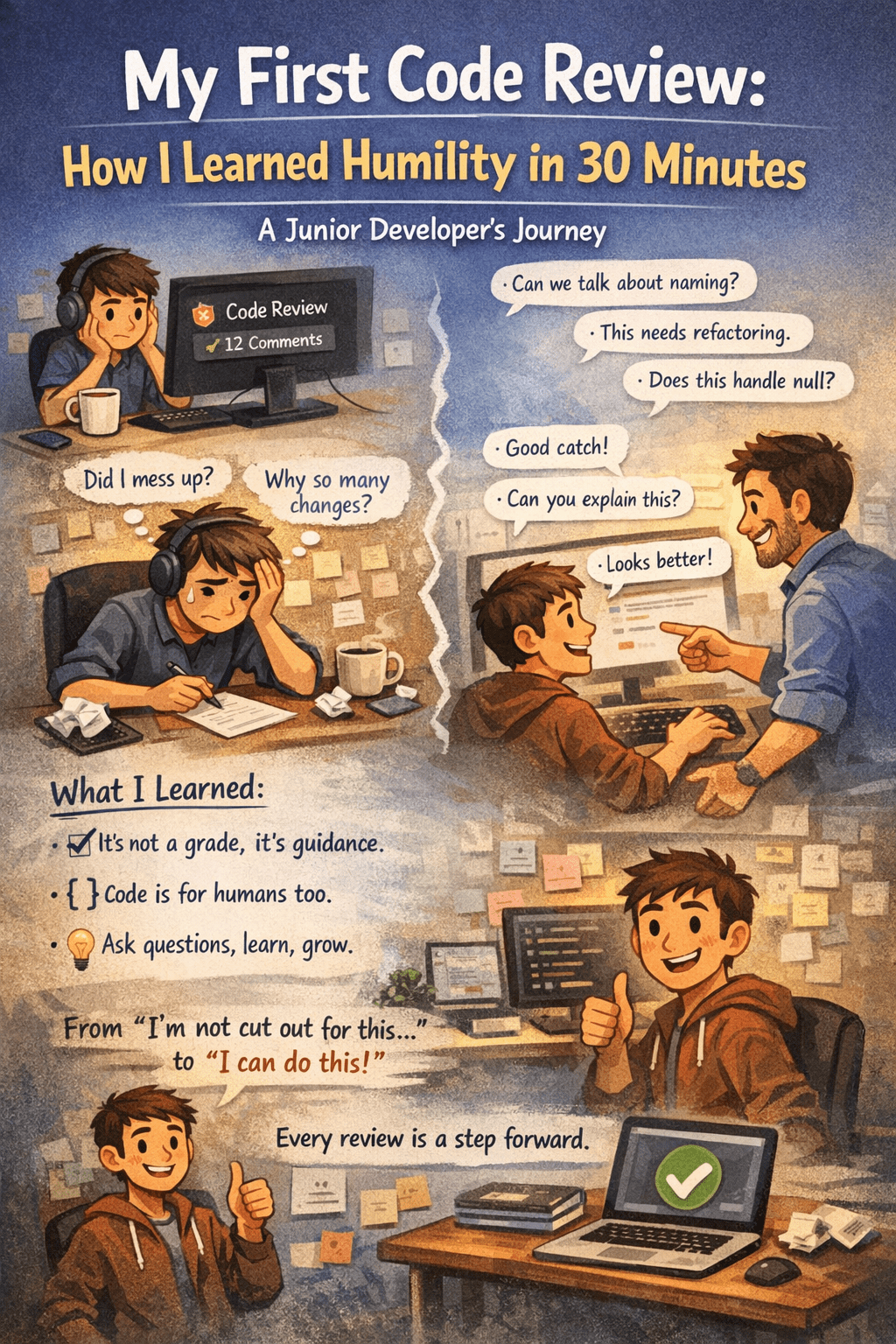
“Can we talk about naming here?”
Okay, fair.
Then:
“This function does two things—can we split it?”
Sure, sure.
Then:
“This condition might break when the input is empty/null.”
Wait… I handled that. Didn’t I?
And then the one that really got me:
“This works, but it’s not very readable. Consider refactoring.”
That was the moment my chest tightened. My brain started doing junior-dev math:
More comments = I’m bad.
Refactor request = I’m not cut out for this.
Question marks = I messed up.
I stared at my PR like it betrayed me.
The code worked. Why did it need to be “more readable”?
In my head, “readable” was a bonus feature.
I thought the job was: make it work.
But code review was teaching me something else:
make it work for the next person too.
My Defensive Era Lasted Exactly 3 Minutes
I did what many junior devs do in silence:
- I re-read my code 20 times
- I tried to justify every line
- I drafted replies like “Actually…”
- I considered deleting my GitHub account and moving to a cabin
Then I noticed something.
None of the comments were mean.
Nobody said “this is terrible.”
Nobody mocked me.
Nobody wrote “How did you even get hired?”
The comments were… specific. Calm. Helpful. Even kind.
One reviewer even added:
“Not a big deal—just want to keep our patterns consistent.”
Consistent. Patterns. Team.
That’s when it clicked: the review wasn’t a personal evaluation.
It was a collaboration.
The problem was I was reading feedback like it was a grade.
It wasn’t a grade.
It was guidance.
The Tiny Mistake That Taught Me the Most
One comment pointed out something small:
“This variable name is confusing.”
I had named a boolean something like isValidCheck (yes, really).
It made sense to me at the time. I was in “ship it” mode.
The reviewer suggested a clearer name:
hasValidEmail- or
isEmailValid
That was it. One rename.
And yet… it changed everything about how the code read.
Suddenly, the condition didn’t feel like a puzzle.
It felt like a sentence.
That’s when I realized: code is communication.
Not just instructions for the computer—
instructions for humans.
And humans are the ones who maintain it at 2 a.m.
The Most Humbling Part
The hardest part wasn’t fixing the code.
The hardest part was admitting that my first version—
the version I was proud of—
could be improved.
Not because I was careless.
Not because I was dumb.
But because I was new.
And being new is allowed.
I’d walked into my first code review expecting approval.
What I needed was perspective.
What I Did Next (And What I’d Tell Past Me)
I took a breath and changed my approach:
1) I stopped replying emotionally
Instead of “But it works,” I tried:
- “Good catch.”
- “Makes sense—updating.”
- “Can you explain why this is preferred?”
2) I treated every comment like a mini-lesson
Even the ones about formatting.
Especially the ones about formatting.
3) I asked one simple question
When I didn’t understand a suggestion, I asked:
“What would make this easier to maintain?”
That question turned the review from “criticism” into “coaching.”
The Ending I Didn’t Expect
After about 30 minutes, I pushed updates and re-requested review.
A few minutes later, the reviewer wrote:
“Nice improvements. This is much clearer now. ✅”
And weirdly… I felt more proud than I did when I opened the PR.
Because this time, it wasn’t just my code.
It was better code.
And I learned something I still carry:
A code review isn’t proof you’re failing.
It’s proof you’re on a team that wants you to grow.
So if your first review feels brutal, you’re not alone.
You’re not behind.
You’re just leveling up—fast.
And one day, you’ll leave thoughtful comments on someone else’s first PR…
and you’ll remember exactly what that “30-minute humility lesson” felt like.
In a good way.