Here are the most common red flags in developer job postings—what they usually mean, and what to ask before you waste time.
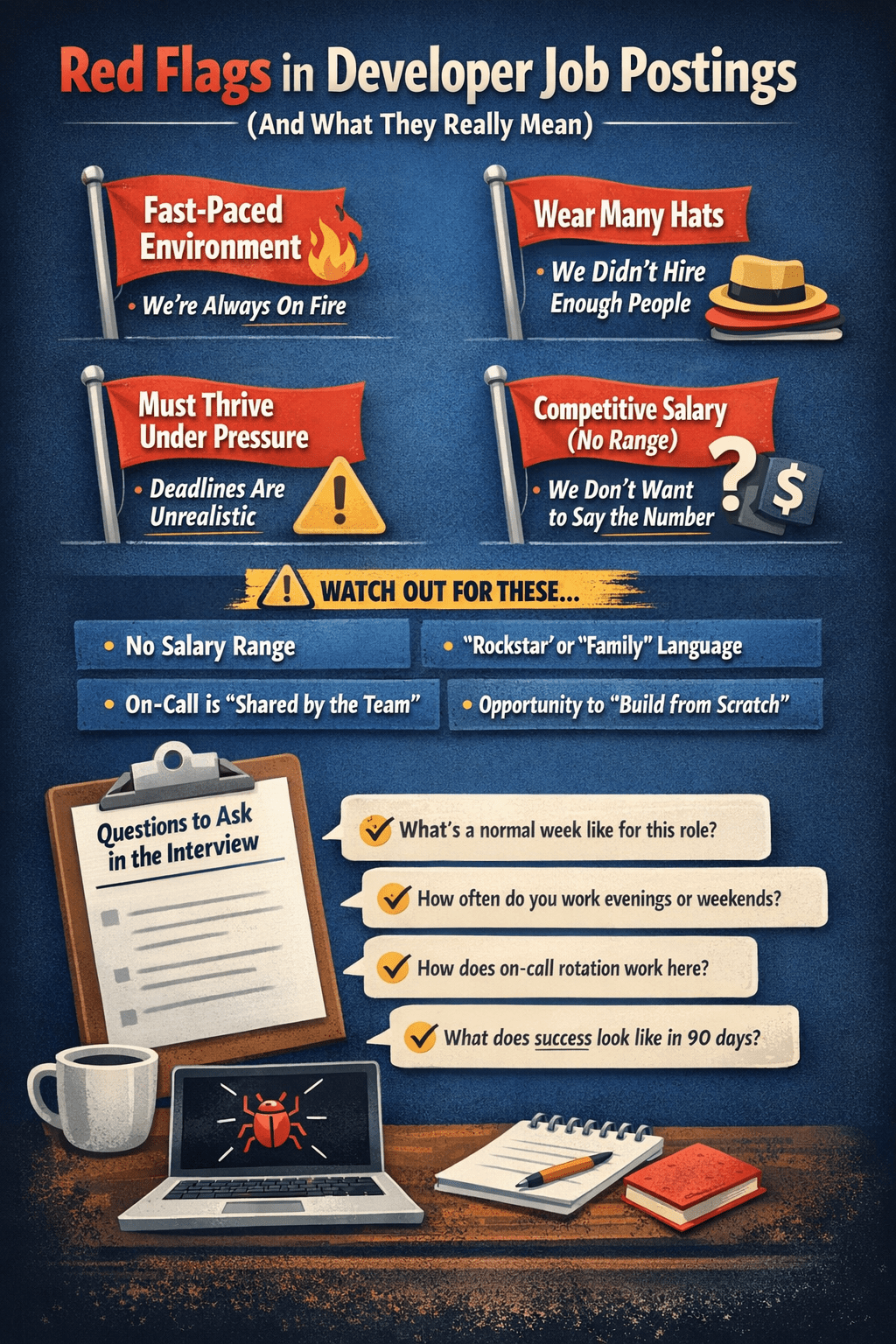
1) Red Flag: “Fast-paced environment”
- Translation: “We’re always on fire.”
- What it often signals: constant context switching, urgent work is normal, no buffers.
- Practical move: Ask: “What caused the last 3 urgent incidents, and what changed after?”
2) Red Flag: “Wear many hats”
- Translation: “We didn’t hire enough people.”
- What it often signals: unclear role boundaries, recurring “temporary” responsibilities.
- Practical move: Ask for a weekly breakdown: % coding vs meetings vs support vs DevOps.
3) “Must thrive under pressure”
- Translation: “Deadlines are unrealistic.”
- What it often signals: pressure is a feature, not an exception.
- Practical move: Ask: “How often do engineers work evenings/weekends in a normal month?”
4) Red Flag: “Rockstar / ninja / wizard”
- Translation: “We want senior output at a discount.”
- What it often signals: hero culture, poor planning, bus-factor risk.
- Practical move: Ask how success is measured in 30/60/90 days and who reviews your work.
5) “Self-starter” (with no mention of onboarding)
- Translation: “We’ll drop you in and hope.”
- What it often signals: weak documentation, tribal knowledge.
- Practical move: Ask: “What does onboarding look like week 1 and week 4?”
6) “Opportunity to build from scratch”
- Translation: “There’s no existing foundation.”
- What it often signals: missing processes, unclear product direction (can be freedom or chaos).
- Practical move: Ask for the roadmap, definition of done, and who owns product decisions.
7) Red Flag: “We’re like a family”
- Translation: “Boundaries may be blurry.”
- What it often signals: emotional pressure to “do extra,” guilt-based culture.
- Practical move: Ask: “What happens when someone says no?”
8) Red Flag: “Competitive salary” (but no range)
- Translation: “We don’t want to say the number.”
- What it often signals: pay may be below market or inconsistent.
- Practical move: Request a salary range early. If they refuse, treat it as data.
9) Red Flag: “Unlimited PTO”
- Translation: “Trackless PTO; people may take less.”
- What it often signals: vague policy, cultural pressure, manager-dependent approvals.
- Practical move: Ask: “What was the average PTO taken by engineers last year?”
10) “On-call is shared by the team”
- Translation: “On-call exists; details hidden.”
- What it often signals: unknown load, weak reliability, alert fatigue.
- Practical move: Ask rotation frequency, pages per week, SLOs, and postmortem practice.
11) “We move quickly; minimal process”
- Translation: “We skip planning and call it agility.”
- What it often signals: no specs, no prioritization, lots of rework.
- Practical move: Ask: “How do you decide what to build next week?” and “Who says no?”
12) “Ability to work independently”
- Translation: “You may be isolated.”
- What it often signals: low collaboration, scarce mentorship, or understaffed team.
- Practical move: Ask about pairing, code reviews, and team sync cadence.
13) “Tight deadlines”
- Translation: “Sales promised something already.”
- What it often signals: commitments made without engineering input.
- Practical move: Ask: “How often does engineering push back successfully?”
14) “We’re scaling rapidly”
- Translation: “We’re changing everything while running.”
- What it often signals: shifting priorities, reorgs, tech debt growth.
- Practical move: Ask: “What broke during the last growth phase, and how did you fix it?”
15) “Must be passionate”
- Translation: “We expect extra emotional labor.”
- What it often signals: “passion” used to justify overtime or low pay.
- Practical move: Ask: “What does a healthy work week look like here?”
16) “Junior role, 3–5 years experience”
- Translation: “We want mid-level for junior budget.”
- What it often signals: title compression, unclear leveling.
- Practical move: Ask for a leveling rubric and examples of true junior-owned projects.
17) “Flexible hours” (but meetings everywhere)
- Translation: “Work whenever—just always be available.”
- What it often signals: schedule creep, time-zone pain.
- Practical move: Ask about core hours, meeting load, async expectations, and response-time norms.
18) “No bureaucracy”
- Translation: “No structure.”
- What it often signals: decisions by whoever shouts loudest.
- Practical move: Ask: “How are architecture decisions recorded and communicated?”
19) “We’re looking for someone to own everything”
- Translation: “You’ll be the only one responsible.”
- What it often signals: bus-factor risk and burnout.
- Practical move: Ask about backup coverage and what happens when you’re off.
20) “Hybrid/remote” (with “as needed” travel)
- Translation: “We can change this anytime.”
- What it often signals: policy instability.
- Practical move: Ask for the policy in writing and how often people are actually onsite.
Quick Red Flag Score (60 seconds)
If you see 3 or more items below with no specifics, be cautious:
- No salary range
- Vague on-call details
- “Fast-paced / pressure / many hats” stacked together
- No mention of onboarding, reviews, or team structure
- “Family / passion / rockstar” language
- Unclear product ownership and prioritization
Questions to Ask in the First Call
- “What does a normal week look like for this role (coding vs meetings vs support)?”
- “How often do you ship? What’s the release process?”
- “How does on-call work (rotation, pages per week, escalation)?”
- “What did the last incident postmortem change?”
- “What does success look like after 30/60/90 days?”