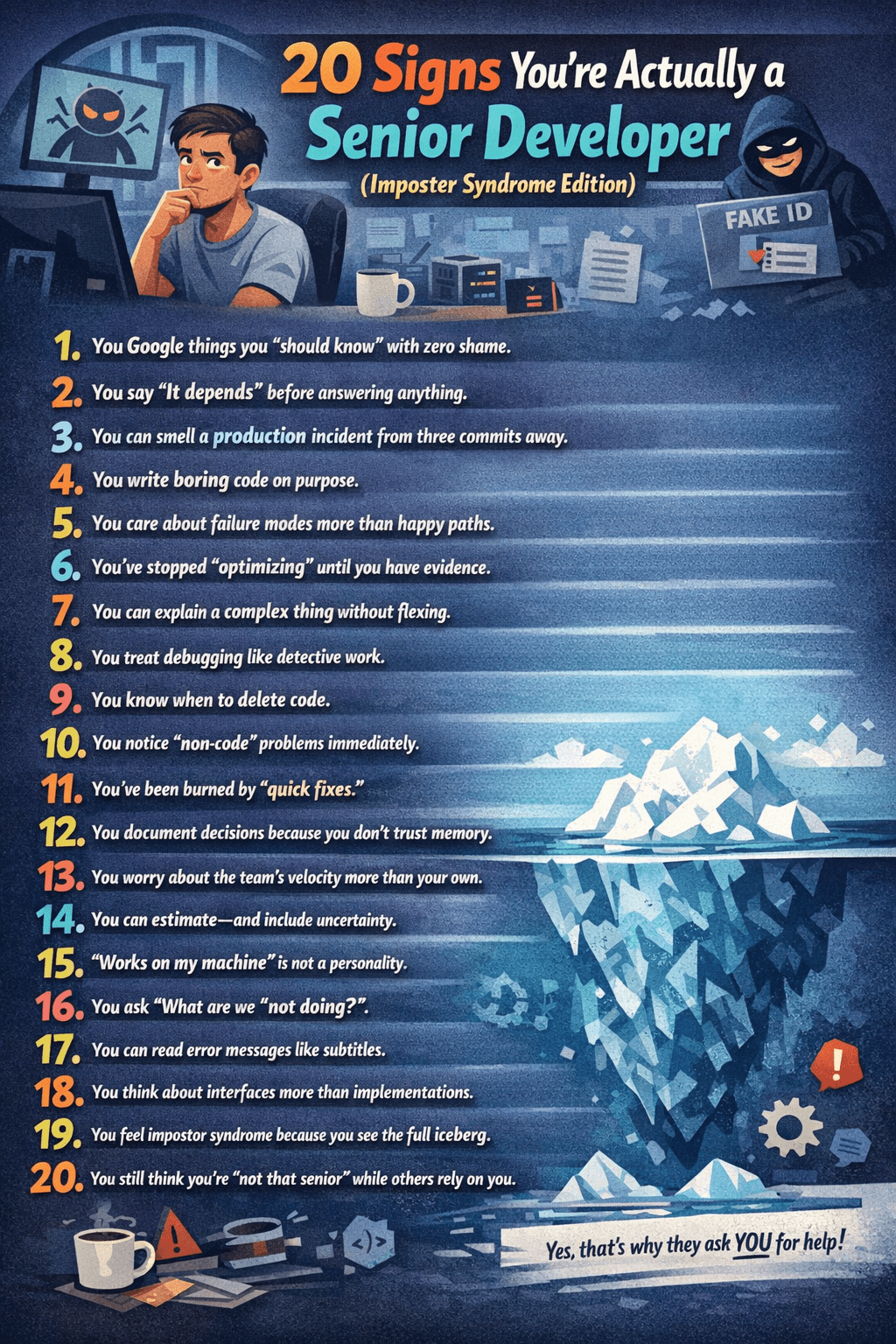
If you’re looking for senior developer signs, you’re probably already there. Here are 20 traits seniors share—funny, practical, and painfully accurate.
- You Google things you “should know” with zero shame.
Seniors don’t memorize trivia—they memorize where to find truth fast. Your browser history is basically a distributed memory system. - You say “It depends” before answering anything.
Not because you’re dodging—because you’ve seen enough edge cases to know reality is a haunted house. “It depends” is wisdom with a seatbelt. - You can smell a production incident from three commits away.
You read a PR and your brain whispers: “This will page us at 2:14 AM.” Congratulations, your trauma has become a feature. - You write boring code on purpose.
Your ego no longer needs cleverness; your future self needs sleep. If it’s readable, it’s senior. - You care about failure modes more than happy paths.
Everyone can make it work on a sunny Tuesday. You’re thinking about timeouts, retries, partial outages, and what happens when the database has a bad day. - You’ve stopped “optimizing” until you have evidence.
You’ve been humbled by benchmarks, caches, and “fast” code that was fast only on your laptop. Now you worship at the altar of profiling. - You can explain a complex thing without flexing.
You don’t need to sound smart—you need others to become smart. If a junior says “ohhh,” that’s your real promotion badge. - You treat debugging like detective work, not a panic attack.
You form hypotheses, gather clues, and calmly narrow the scope. You still panic a little, but professionally. - You know when to delete code.
Adding features is fun; removing complexity is senior sport. You’ve learned that fewer lines often means fewer nightmares. - You notice “non-code” problems immediately.
Ambiguous requirements, missing ownership, unclear success metrics—your spidey sense tingles. You fix the meeting before you fix the bug. - You’ve been burned by “quick fixes,” so you’re politely stubborn.
You can do it fast, but you can also explain why fast becomes expensive later. You’re basically the adult in the room with a gentle “no.” - You document decisions because you don’t trust memory.
Not because you’re perfect—because you’re realistic. Your past self is a stranger who makes wild choices. - You worry about the team’s velocity more than your own.
You build tools, patterns, and guardrails that help everyone ship. Your impact is measured in fewer “wait, how does this work?” messages. - You can estimate—and include the uncertainty.
You don’t say “two days,” you say “2–5 days depending on X and Y.” That’s not weakness; that’s battle-tested forecasting. - You’ve learned that “works on my machine” is not a personality.
You understand environments, configs, and the dark arts of deployment. You’ve been betrayed by a missing env var and you’ll never love again. - You ask “What are we not doing?”
Scope is a beast, and you’ve learned to leash it. Seniors don’t just build—they choose what to ignore. - You can read error messages like subtitles.
Not instantly, not always, but you know where to look and what to try next. You’ve developed a calm relationship with red text. - You think about interfaces and contracts more than implementations.
You care how things fit together, not just how they work inside. You’ve learned that integration is where hope goes to die. - You feel impostor syndrome because you see the full iceberg.
Beginners see the tip and think “easy.” You see the submerged chaos and think “who approved existence?” - You still think you’re “not that senior” while others rely on you.
If people ask you to review critical stuff, unblock them, or explain the system… surprise: you’re already it. Impostor syndrome is just your brain buffering.