If you’ve ever watched a team chat melt down over a single invisible character, congratulations: you’ve witnessed the most durable conflict in software history. The tabs vs spaces debate is the formatting war that refuses to die—not because it matters that much, but because it feels like it does.
So let’s do this properly: point/counterpoint, fair to both sides, and just controversial enough to farm comments.
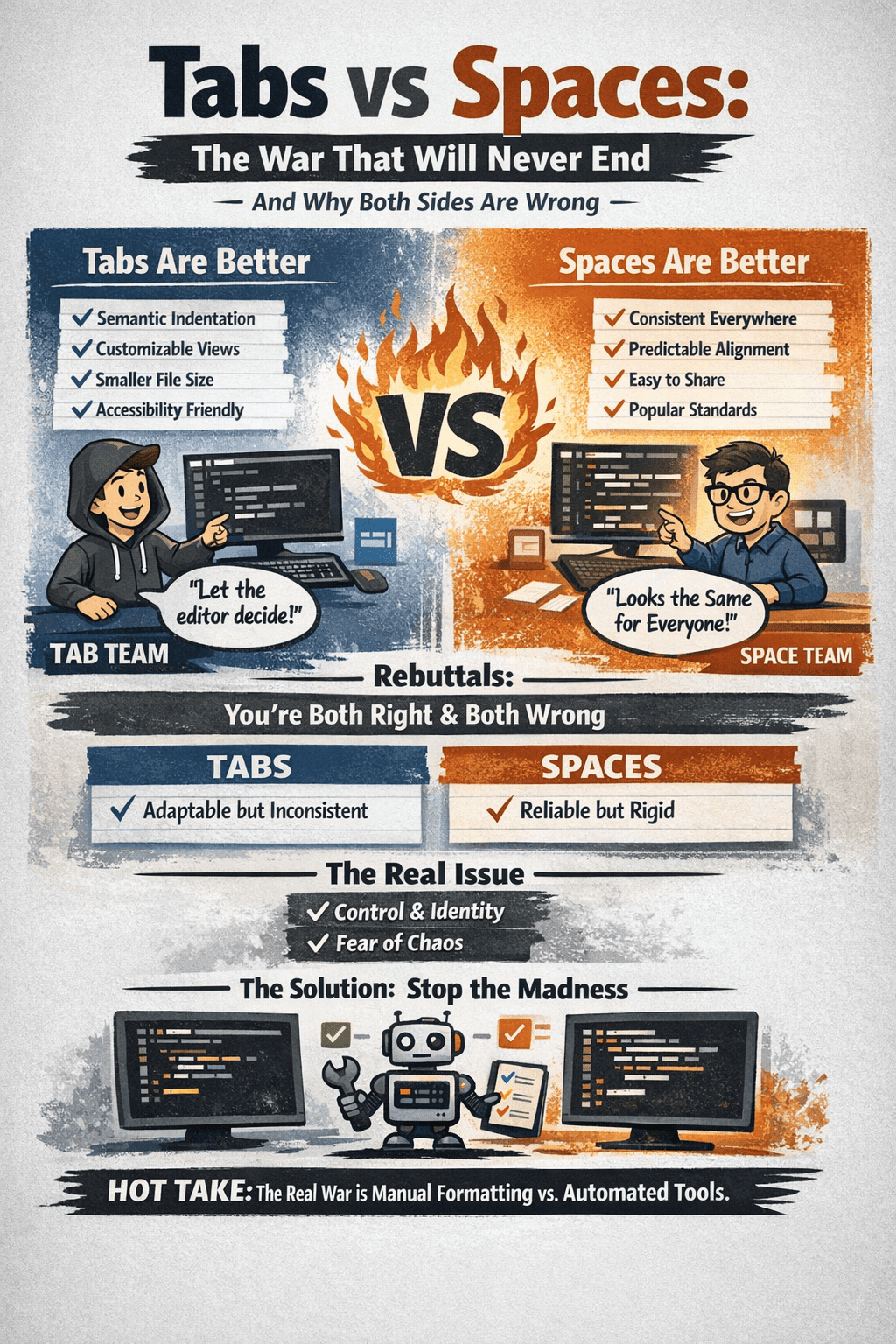
Point: Tabs Are Better (The Tab Team Case)
1) Tabs are semantically indentation
A tab is literally “indent one level.” That’s meaning, not measurement.
Spaces are just… a bunch of characters pretending to be structure.
Tab argument: Indentation should represent levels, not widths.
2) Tabs respect personal viewing preferences
Want indentation at 2 spaces? 4? 8? Tabs let each developer choose what’s readable without changing the actual file.
Tab argument: Code should be consistent in structure, flexible in display.
3) Tabs reduce keystrokes and file size (yes, it matters sometimes)
Less typing, fewer characters, slightly smaller diffs in some situations. It’s not a massive win, but it’s a win.
Tab argument: Why type four spaces when one character does the job?
4) Accessibility + readability
Some devs need larger indentation widths to read nested code comfortably. Tabs can adapt.
Tab argument: Tabs are friendlier to different reading needs.
Tab Team’s closer: Tabs keep the meaning of indentation while letting the editor decide how it looks. Spaces force one person’s preference on everyone.
Counterpoint: Spaces Are Better (The Space Team Case)
1) Spaces render consistently everywhere
Tabs look different across editors, IDEs, terminals, viewers, diffs, email previews, GitHub, and that one weird tool in your pipeline nobody remembers owning.
Space argument: Consistency beats elegance.
2) Alignment is predictable
When you need to align things (object literals, tables in comments, ASCII formatting), tabs can cause chaos depending on tab width settings.
Space argument: Tabs are a variable-width character pretending not to be.
3) Collaboration is easier
Spaces are the lowest-common-denominator. There’s no “but my editor shows it differently.”
Space argument: Shared code needs shared visuals.
4) Most style guides + ecosystems default to spaces
A ton of popular ecosystems have conventions built around spaces (and tools set up accordingly). Even when tools can handle tabs, teams often standardize on spaces because it reduces friction.
Space argument: Convention saves time and arguments.
Space Team’s closer: If your code looks the same to every person and tool, you eliminate a whole category of pointless diff noise and formatting surprise.
Rebuttals (Where Each Side Has a Real Point… and a Real Blind Spot)
Tabs are right about…
- Indentation is structure, not decoration.
- Accessibility matters, and tabs can adapt.
- “Let the editor display it” is a good concept.
Tabs are wrong because…
- The world is full of tooling that treats tabs inconsistently.
- “Everyone can set their tab width” is true in theory, false in practice.
- One dev with a different config can make the code look like a staircase designed by M.C. Escher.
Spaces are right about…
- Predictability wins in teams and tooling.
- Consistent diffs are a productivity multiplier.
- “It looks the same everywhere” is a major collaboration advantage.
Spaces are wrong because…
- They confuse representation with meaning.
- They lock in a visual preference (2 vs 4) as if it’s objective truth.
- They often create pseudo-religion: “spaces are professional,” which is… a vibe, not a reason.
The Real Problem: This Debate Isn’t About Tabs or Spaces
It’s about:
- Control (“my code should look like this”)
- Identity (“serious devs use X”)
- Fear of chaos (inconsistent formatting feels like inconsistent engineering)
And because indentation is invisible, the human brain fills in the blanks with emotion.
That’s why it never ends.
The Only Fix That Actually Works (And Nobody Wants to Admit)
Pick one. Enforce it. Stop thinking about it.
Use formatting tools (formatter + editorconfig + pre-commit checks). Make it impossible to argue because it becomes impossible to drift.
Not because one is morally superior—because arguments are expensive.
Hot Take Ending: Both Sides Are Wrong, and Here’s Why
The correct answer in 2026 is:
If your team is still debating tabs vs spaces, you don’t have a formatting problem—you have a tooling and standards problem.
The “right” indentation is the one your formatter enforces automatically while you focus on logic.
So yes:
- Tabs people are right about semantics,
- Spaces people are right about consistency,
…and both are wrong for treating a solved automation problem like a personality test.
Real hot take: The real war isn’t tabs vs spaces.
It’s people who format manually vs people who let tools do it.